

Overview and history
There are places you visit for the scenery and where you discover, almost by chance, an extraordinary story. The Seychelles are one of them.
This archipelago of 115 islands, set in the middle of the Indian Ocean, has some remarkable features. Its granite rocks are older than the dinosaurs. Its first permanent inhabitants only arrived in the 18th century. Some of its plants grow naturally nowhere else, and its giant tortoises can live far longer than the humans who come to admire them.
But the Seychelles are not just a natural sanctuary. They are also the product of a singular human history, born of encounters between African, European and Asian peoples, of slavery, of maritime trade and of the birth of a Creole culture all their own. To understand this archipelago, you have to start with a journey through time. A very long journey.
The Seychelles, fragments of a lost continent?
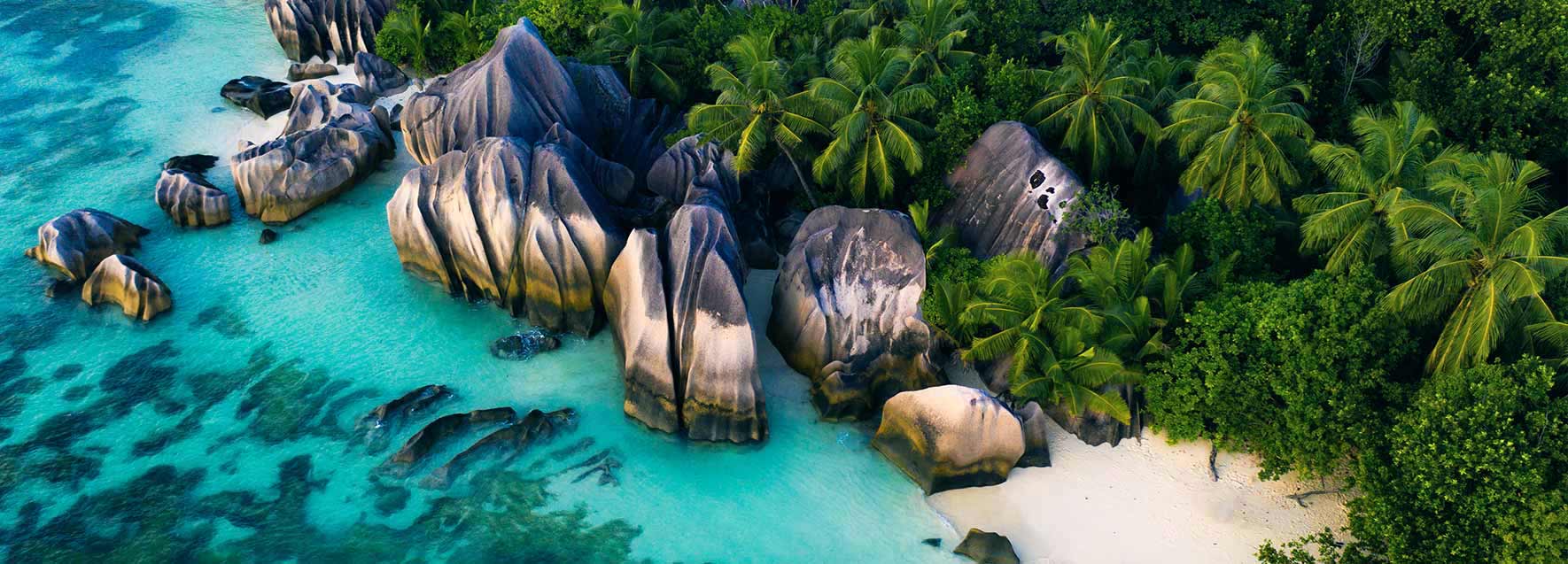
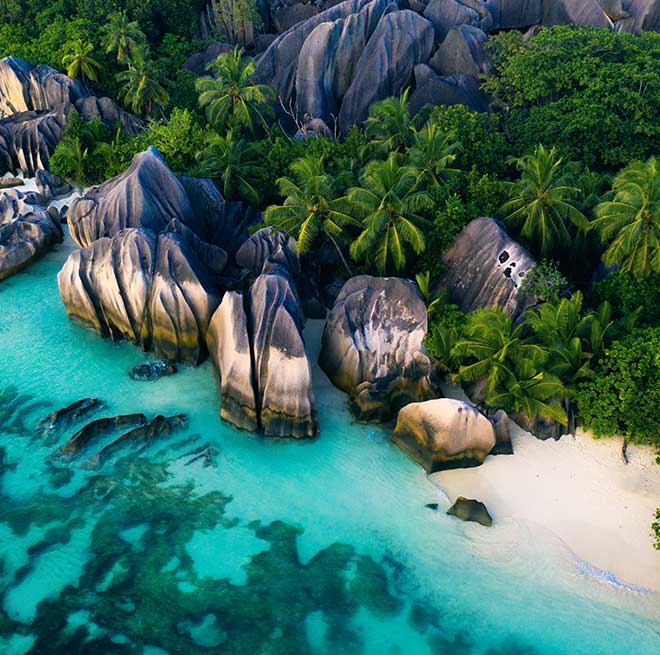
The famous rounded rocks of the Seychelles have something strange about them. Unlike the volcanic landscapes of many tropical islands, these huge granite boulders look as if a giant hand had placed them there. And with good reason: they tell a story that goes back several hundred million years.
When the continents were not yet where they are today
A very long time ago, the lands that now make up Africa, Antarctica, India, Madagascar and Australia belonged to one vast continental mass: Gondwana. As the tectonic plates moved, this supercontinent gradually broke apart.
The granitic islands of the Seychelles are the visible parts of a fragment of continental crust left isolated in the Indian Ocean during the successive separations between India and Madagascar. This is a major geological peculiarity: most oceanic archipelagos form through the build-up of volcanic rock or the growth of coral. The granitic Seychelles, on the other hand, rest on a genuine piece of continent.
The granite of some of these islands is around 750 million years old. By comparison, the first dinosaurs appeared some 230 million years ago. The rocks of the Seychelles were therefore already several hundred million years old when the dinosaurs began to roam the Earth.
Why are these rocks so rounded?
Their characteristic shape is the result of very long weathering. Under the effect of water, heat and chemical processes, the granite gradually weakens along its cracks. The corners weather faster than the flat surfaces, eventually producing large rounded boulders. Erosion then carries away the looser material and reveals these huge rock masses. This phenomenon, known as spheroidal weathering, largely explains the granite landscapes for which the Seychelles are famous today.
DID YOU KNOW? The Seychelles are made up of two main groups: the inner islands, mostly granitic, and the outer islands, mostly coral. A single country thus brings together very old continental rocks and islands shaped by marine organisms.
Long-uninhabited islands, seafarers and a few pirates
For thousands of years, the Seychelles existed without any known permanent human population. That is quite rare for a tropical archipelago, especially given the long history of navigation in the Indian Ocean.
Arab merchants, navigators from East Africa and Asian sailors were crossing these waters long before the Europeans arrived. Some of them may have known or sighted the Seychelles, although evidence of early visits remains limited. The first European mentions date back to the Portuguese expeditions of the early 16th century. In 1609, sailors from the English East India Company made the first documented European landing in the archipelago.
The Seychelles are named after a French minister
In the 18th century, France took an interest in the archipelago for its position on the sea routes. In 1756, Captain Corneille Nicolas Morphey officially took possession of the islands in the name of Louis XV. The archipelago was named in honour of Jean Moreau de Séchelles, a former controller-general of finances of the kingdom. That is how an 18th-century French minister came to be forever associated with an archipelago in the Indian Ocean.
The first permanent settlement was founded on 27 August 1770 on Sainte-Anne Island by a small group of settlers and people from Africa and India, several of whom were enslaved. The human history of the Seychelles therefore began relatively late, and from the very beginning it was marked by relations of domination and by the meeting of peoples from several continents.
And where do the pirates come in?
The Seychelles have long been associated with the pirates who roamed the Indian Ocean in the late 17th and early 18th centuries. The trade routes linking Europe, Africa and Asia carried valuable goods; the archipelago, isolated and little visited, could offer temporary shelter.
The best-known story is that of Olivier Levasseur, nicknamed La Buse (“the Buzzard”), a French pirate who prowled the Indian Ocean. In 1721, he took part in the capture of a Portuguese ship carrying a considerable treasure, off Réunion Island. According to a legend embellished long after his death, La Buse left behind a cryptogram leading to his treasure. Treasure hunters have searched the Seychelles, notably around Bel Ombre on Mahé, without any convincing proof that the famous loot has been found.
DID YOU KNOW? La Buse really existed and was hanged on Réunion Island in 1730. However, the cryptogram and the treasure hidden in the Seychelles are not historically established. The real pirate must be distinguished from the legend.
How was Seychellois culture born?
The human history of the Seychelles is relatively recent, but it has produced an original culture. From 1770, French settlers developed agriculture, including spices, cotton and later coconut palms. These plantations relied largely on the labour of enslaved African and Malagasy people.
At the beginning of the 19th century, the British gradually took control of the archipelago. Their rule was definitively recognised by the Treaty of Paris in 1814. The Seychelles became a British colony, but kept a strong French linguistic and cultural imprint.
A Creole language born of forced encounters
On the plantations and in the colonial settlements, people from different backgrounds had to communicate. It was in this context that Seychellois Creole, known as Kreol Seselwa, developed. Its vocabulary comes mostly from French, but it has its own grammar and has evolved through contact with the archipelago’s different populations.
Today, the Seychelles recognise three official languages: Seychellois Creole, English and French. Creole plays a central role in everyday life and culture. A French-speaking visitor may recognise many words without understanding every conversation: Seychellois Creole is a language in its own right, not simply French spoken with a tropical accent.
The abolition of slavery and a changing society
Slavery was abolished in the British Empire in the 1830s, with emancipation implemented in the Seychelles in 1835. Abolition did not immediately put an end to inequality. During the 19th century, Africans freed from slave ships intercepted by the British navy were also brought to the Seychelles. Other populations arrived from India and China, contributing to the country’s trade and cultural diversity.
Today, the cuisine, festivals, religious practices, music and family traditions bear witness to these African, European and Asian legacies.
1976: the birth of an independent state
On 29 June 1976, the Seychelles became independent from the United Kingdom. A coup in 1977 led to the establishment of a socialist regime, followed by a one-party system. Multi-party politics was reintroduced in the early 1990s and a new Constitution was adopted in 1993. National identity was thus built on multiple legacies and on a very strong relationship with the island environment.
DID YOU KNOW? In the Seychelles, “bonzour” means hello and “mersi” means thank you. This familiarity with French is a way into the language, but no reason to confuse the two.
The coco de mer and the extravagances of evolution
In the Seychelles, nature sometimes seems to have taken a few liberties with the usual rules. Palm trees produce gigantic seeds. Tortoises reach impressive sizes. Birds, frogs and plants have evolved in such prolonged isolation that they are found naturally nowhere else.
The islands’ isolation limited the exchange of species with the continents. Some populations therefore evolved independently, giving rise to endemic species, unique to one territory. And among them, one plant undoubtedly deserves first prize in the contest of botanical oddities.
The coco de mer, a nut that has caused quite a stir
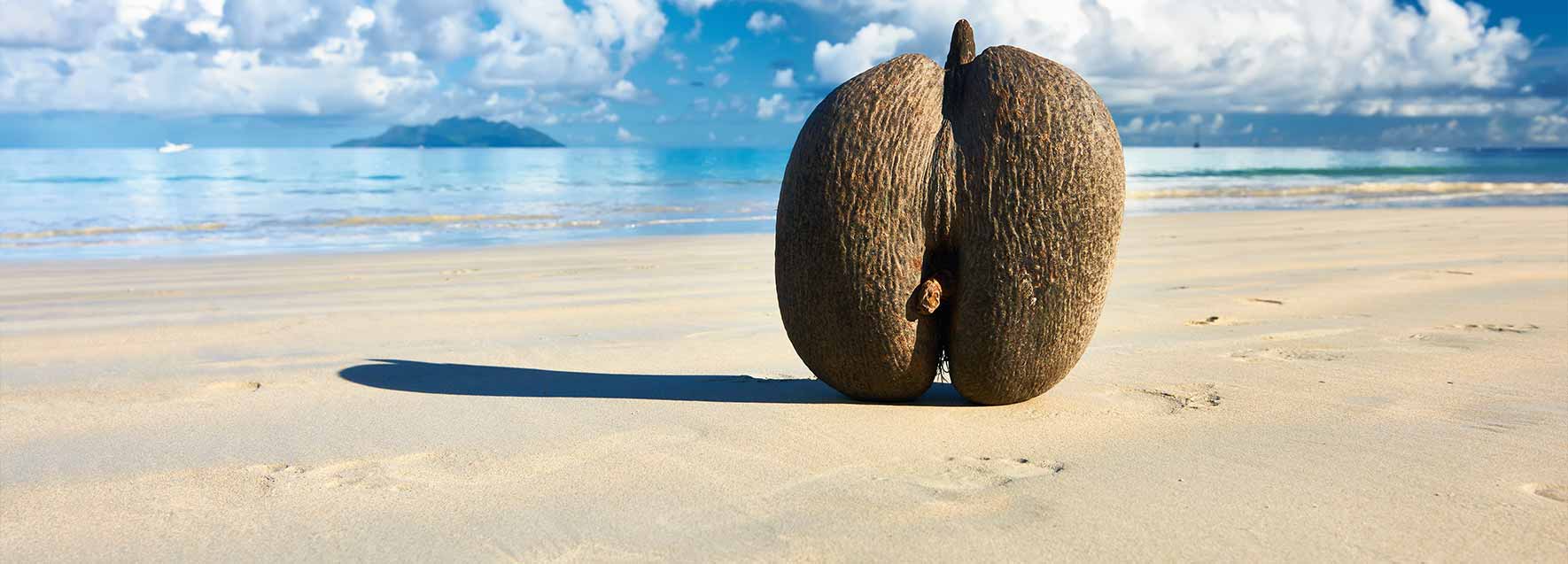
The coco de mer, or Lodoicea maldivica, is a palm that grows naturally on Praslin and Curieuse. It produces the largest known seed in the plant kingdom, which can weigh more than 15 kilograms. Its shape, with two rounded lobes evoking a woman’s hips, earned it the nickname “coco-fesse” (bottom coconut).
For centuries, seeds washed up on the shores of the Indian Ocean, notably in the Maldives, without anyone knowing where they came from. Some imagined underwater trees, in mysterious forests at the bottom of the ocean. Their rarity made them precious objects, sometimes credited with extraordinary powers.
DID YOU KNOW? The scientific name Lodoicea maldivica refers to the Maldives, where the seeds were found. Yet the palm does not grow there naturally. The ripe seeds that had drifted over long distances had lost their ability to germinate.
The Vallée de Mai, an almost prehistoric forest
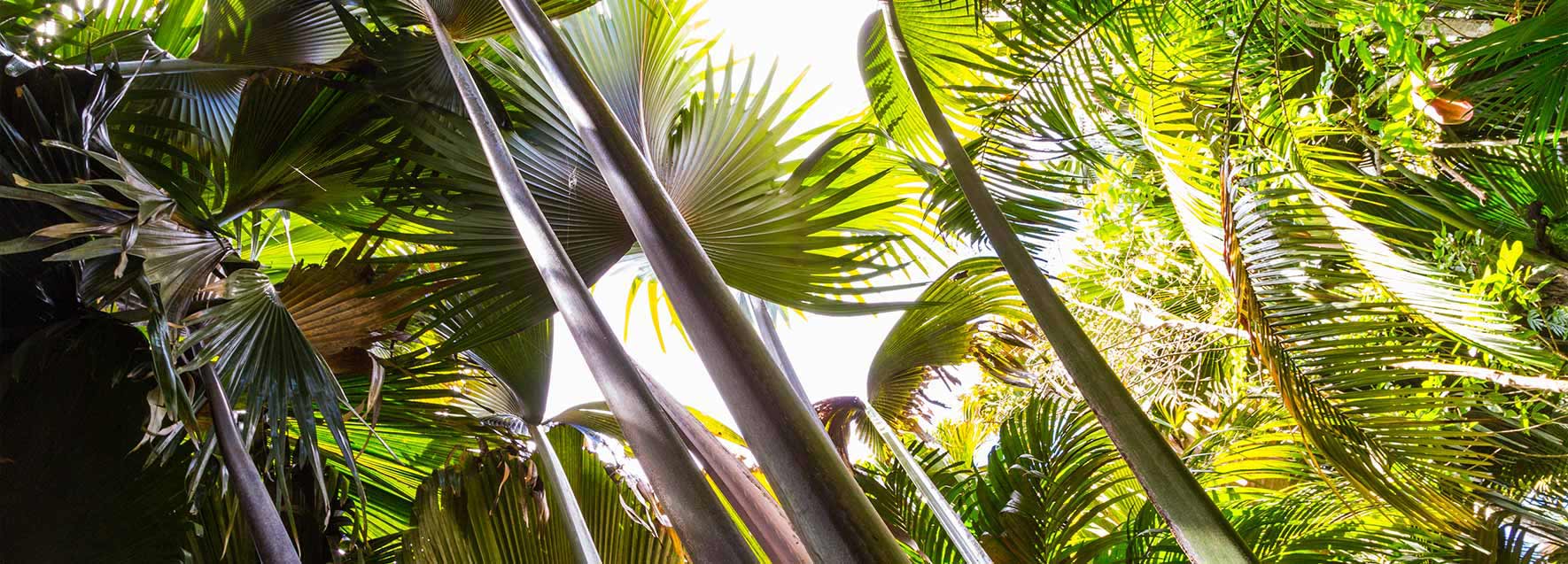
On Praslin, the Vallée de Mai is home to one of the most remarkable populations of coco de mer. This palm forest, listed as a UNESCO World Heritage Site in 1983, covers a protected area of around 19.5 hectares. It is home to several endemic palms and rare animals, including the Seychelles black parrot.
Its gigantic fronds, dense vegetation and unique species give an idea of what some Seychelles forests may have looked like before the great human transformations. It is no coincidence that it has sometimes been compared to a Garden of Eden.
Why did the tortoises become giants?
Island gigantism is observed in certain species that evolve on islands for a long time. In the absence of certain predators and under particular ecological conditions, animals can develop sizes very different from those of their mainland relatives. The giant tortoises of the Seychelles are a remarkable example. But not all island species become giants: some evolve towards dwarfism instead. Nature does not follow a single recipe.
Aldabra, a natural laboratory at the far end of the archipelago
More than 1,000 kilometres south-west of Mahé, one territory plays a major role in the scientific reputation of the Seychelles: Aldabra. This immense coral atoll, made up of four main islands surrounding a lagoon, is one of the great natural sanctuaries of the Indian Ocean.
Unlike the granitic islands, Aldabra is a raised coral formation. Its remoteness, the difficulty of access and the absence of any significant permanent settlement have helped preserve a large part of its ecosystems.
The kingdom of the giant tortoises
Aldabra is home to the world’s largest natural population of giant land tortoises, with around 100,000 individuals according to commonly cited estimates. These tortoises can weigh several hundred kilograms and live for more than a century. By eating vegetation and dispersing seeds, they help shape the atoll’s landscapes. In a way, they are large, four-legged and particularly patient gardeners.
DID YOU KNOW? A giant tortoise can carry seeds as it moves around. Some pass through its digestive system and are deposited elsewhere, together with a perfectly natural fertiliser. Ecological gardening existed long before garden centres.
A sanctuary on the World Heritage List
Aldabra has been a UNESCO World Heritage Site since 1982, one year before the Vallée de Mai. The atoll makes it possible to study evolution in an island environment and the functioning of relatively undisturbed ecosystems. It is also home to many seabirds, fish, sharks and sea turtles. Its protection relies on strict regulations and limited access.
Aldabra is not a stop on CATLANTE cruises. Its place in this guide is cultural: it helps explain why the Seychelles hold such an important position in the history of biodiversity conservation.
A people turned towards the sea: fishing, navigation and ocean protection
In the Seychelles, the sea is not just scenery. Ever since the first inhabitants settled, it has been a means of getting around, a source of food and a major economic resource. In a country of 115 islands scattered across a vast area of the Indian Ocean, boats have long been essential for travel and for carrying goods.
Fishing, an activity deeply rooted in the culture
Small-scale fishing has long played an important part in Seychellois life. Fishermen use lines, traps and techniques adapted to the species and the seabed. But the activity is not limited to small coastal boats: the archipelago is also a major player in tuna fishing in the Indian Ocean, centred on the port of Victoria.
This coexistence of small-scale and industrial fishing raises major economic and environmental issues.
Islands linked by navigation
Before air links and modern infrastructure, traditional boats were already linking communities, carrying people, crops, materials and goods. The means have changed, but the sea continues to play its role as a link.
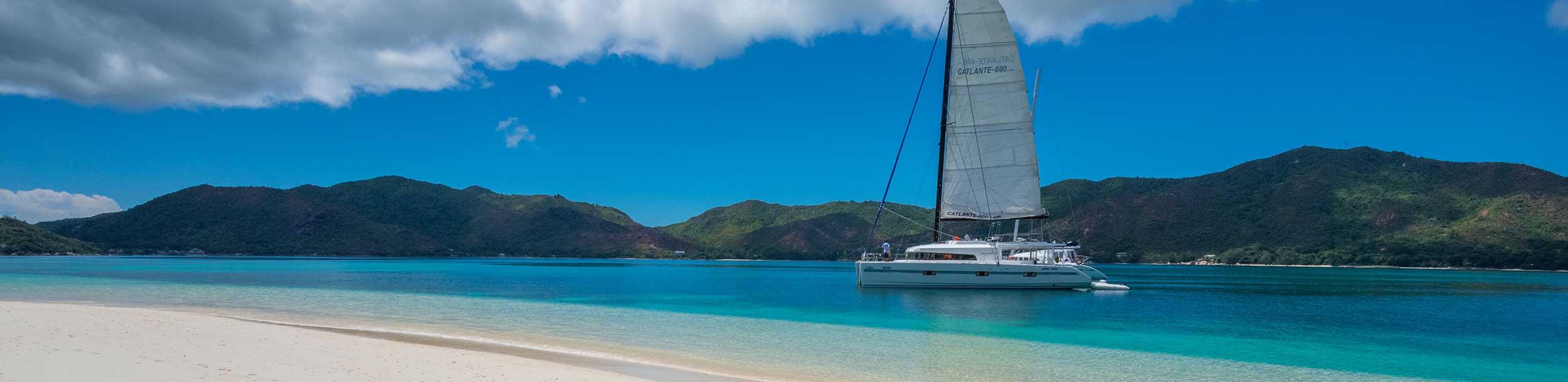
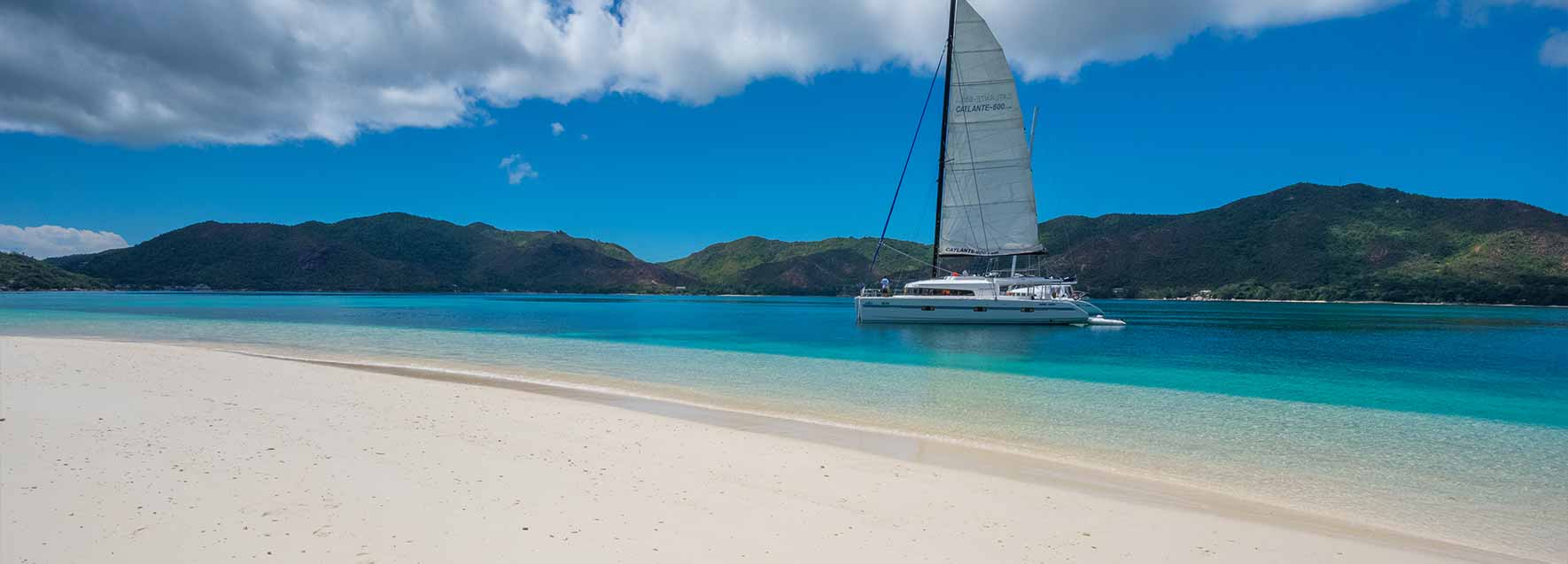
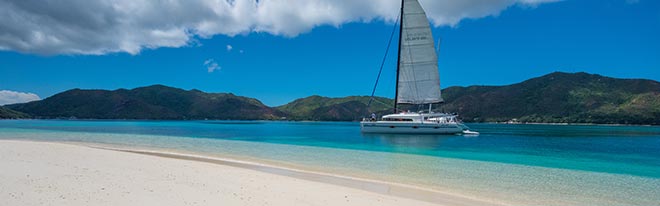
This is also what makes a catamaran cruise in the Seychelles so consistent with the geography of the archipelago: it lets you discover several territories in a single trip, without reducing the Seychelles to one island.
Coral reefs under pressure
Seychelles waters are home to coral reefs, seagrass beds and many habitats essential to biodiversity. Reefs serve as breeding, feeding and shelter areas for fish and help to dampen the energy of the waves.
Warming waters cause coral bleaching events, while some human activities increase the pressure on these environments. The Seychelles are developing policies for marine protection, reef restoration and ocean resource management. The challenge is to preserve biodiversity while maintaining the economic activities on which the population depends.
A tiny country on land, immense at sea
The land area of the Seychelles is around 455 km², but their exclusive economic zone covers some 1.3 million km² of ocean. This disproportion explains the strategic importance of the sea for the country’s future: fishing, tourism, transport, conservation and scientific research all depend directly on it.
DID YOU KNOW? Seen from land, the Seychelles are a tiny country; seen from the sea, they are an immense maritime territory.
On a catamaran cruise, the passages between the islands are therefore not just a way of getting from one place to another. They help you understand the geography of this territory and the ties that bind its different communities.
The Seychelles, much more than a holiday archipelago
The Seychelles bring together stories that unfold on radically different timescales. That of the Earth, which began hundreds of millions of years ago; that of nature, which took advantage of isolation to produce astonishing life forms; and that of humankind, much more recent but just as rich.
Today these stories meet in a country where the sea plays an essential role. Discovering the Seychelles from island to island is therefore much more than collecting white sand beaches. It means exploring a territory where geology, the evolution of life and human history have produced a singular world.
And the next time you see a huge granite boulder sitting at the water’s edge, remember: it was already there, in one form or another, long before the dinosaurs. It perhaps deserves a little more than a photograph.
How to get there
Reach Mahe, in the Seychelles, easily
By plane
Departure the day before (on Friday for a Saturday boarding, on Sunday for a Monday boarding) and arrival on the day of boarding at 4 p.m.
- From France: Emirates (stopover in Dubai), Qatar Airways (stopover in Doha), Etihad Airways (stopover in Abu Dhabi), Ethiopian Airlines (stopover in Addis Ababa), Turkish Airlines (stopover in Istanbul).
- From Belgium: Emirates (stopover in Dubai), Qatar Airways (stopover in Doha), Etihad Airways (stopover in Abu Dhabi), Ethiopian Airlines (stopover in Addis Ababa), Turkish Airlines (stopover in Istanbul).
- From Luxembourg: Turkish Airlines (stopover in Istanbul).
- From Switzerland: Emirates (stopover in Dubai), Qatar Airways (stopover in Doha), Turkish Airlines (stopover in Istanbul).
Things to know before you go
CATLANTE cruises depart from Eden Island marina on Mahé all year round. In 2026 the departure day changes from Saturday to Monday, with both days running side by side on a few dates.
For EU nationals: valid passport for each participant. Authorization to leave the country for minors traveling without at least one parent or legal guardian. You must apply for travel authorization three days before departure on the dedicated website: seychelles.govtas.com. It's quick and easy, costs €11 and is always granted, provided your passports are valid and your accommodation reservations have been made. An environmental protection tax of 100 SCR/day/person over 12 years of age is payable on site.
Boarding takes place at Eden Island marina, between the airport and Victoria, the capital, at 4pm. Disembarkation takes place in the morning at 8am on D+7.
Airport cabs. Approx. €30 from Victoria airport to Eden Island marina.
Luggage storage opposite the VPM office: the Semi-sub café offers luggage storage in a secure room with video surveillance. Rate: €10/case or large bag €5/luggage under 7kg
Admission to Vallée de Mai: 450 SCR (€30) on site, 410 SCR if purchased online at sif.sc/vdm, cab from the boat to Vallée de Mai: approx. 450 SCR (€30) per person - Bike rental at La Digue: 250 SCR (€17) for a classic bike (other rates for mountain bikes and electric bikes) - Admission to Union Estate for Anse Source d'Argent beach at La Digue: 115 SCR (€8)
The local currency is the Seychelles rupee: €1 = 15 SCR. This is a non-exportable currency, so you can exchange it when you arrive at the airport. The climate in the West Indies is equatorial, with very little difference between the dry season in summer and the wet season in winter. The Seychelles lie outside the cyclone belt. The official languages of Seychelles are Seychellois Creole, English and French.
Enjoy your trip with CATLANTE Catamarans
Join as a cabin guest or charter your own catamaran with a professional crew.
An all-inclusive experience designed purely for the pleasure of sailing and discovering in a small group.
The French leader
for 20 years
The tranquility
of the all-inclusive
A local and quality
cooking
French flag,
French-speaking crews
Eco-responsible
holidays