

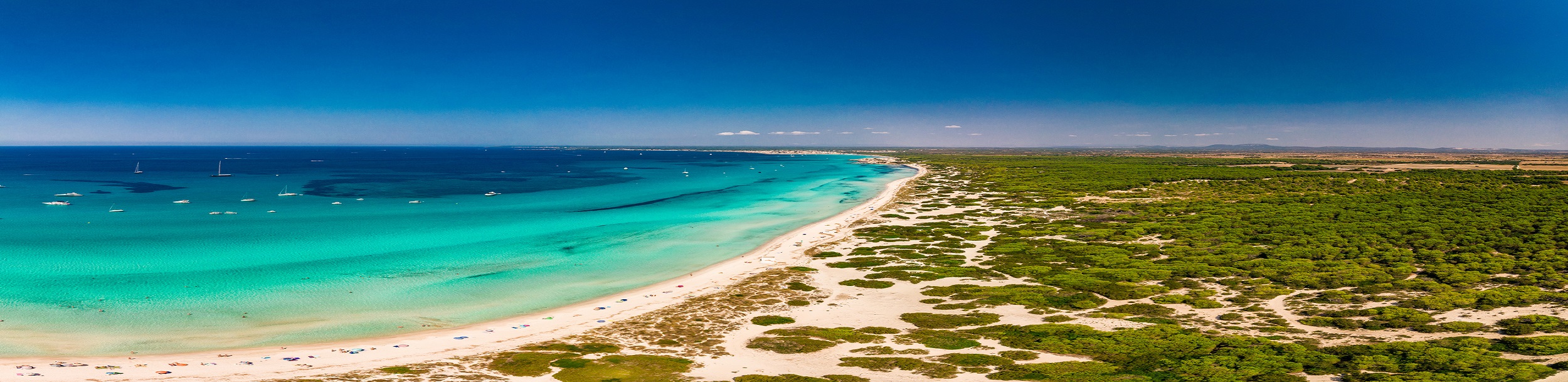
History and general information
Majorca and Minorca lie just a few hours’ sailing apart, yet their histories are not quite alike. The first saw merchant towns, palaces and thinkers flourish. The second preserves an exceptional prehistoric heritage and the unexpected traces of a century of European rivalries. Both bear the imprint of the sea, which brought as many visitors as conquerors.
To discover them, let us start well before the Romans arrived, at a time when people on Minorca were already building monuments that still intrigue archaeologists.
1. Minorca, an island of mysterious prehistoric monuments
In the Minorcan countryside, among dry-stone walls and fields, structures sometimes appear that seem to defy the centuries: massive towers, funerary buildings shaped like an upturned hull and monumental stone tables. They are not the set of an adventure film, but the remains of island societies from the Bronze Age and the Iron Age.
Talayots, navetas and taulas: three forms, three enigmas
Talayots are large stone structures, usually tower-shaped. Their role may have varied from place to place and from one period to another: organising space, communal or symbolic functions. Navetas, whose outline recalls an upturned boat, are associated in particular with collective funerary practices. As for taulas, those astonishing assemblies of two blocks forming a T, they often stand at the centre of enclosures with a ritual purpose.
The Naveta des Tudons, near Ciutadella, has become one of the emblems of Minorcan prehistory. But perhaps the most remarkable thing is the density of these remains on a relatively small island. You do not just come across a few isolated monuments: together they form a genuine archaeological landscape.
World Heritage status since 2023
In 2023, UNESCO inscribed “Talayotic Menorca” on the World Heritage List. The listing covers a group of sites that bear witness to the evolution of prehistoric communities and their cyclopean buildings. Much remains to be learned about their social organisation, their beliefs and their exchanges with the rest of the Mediterranean. And that is precisely what makes these stones so fascinating: they do not give up all their answers.
DID YOU KNOW? Taulas are characteristic of Minorca. Their T shape is so unusual that interpretations long abounded. Today, archaeologists study their ritual context rather than assigning them a single, certain function.
2. Majorca, a crossroads of Mediterranean civilisations
The Mediterranean has never been a watertight border. For the sailors of Antiquity, it was first and foremost a network of routes, trading posts and harbours. The Balearics lay on these routes, between the Iberian Peninsula, the south of France, North Africa and the islands of the western Mediterranean.
From Balearic slingers to Roman towns
In Antiquity, the inhabitants of the Balearics were renowned for their skill with the sling. The very name of the archipelago is sometimes linked to this warrior tradition, although its etymology is still debated. In 123 BC, Rome conquered the islands. It developed urban centres and trade there, a legacy still carried by Palma and Pollentia.
After Antiquity, the islands went through several changes of power. Muslim rule, from the 10th century onwards, had a lasting effect on their agriculture, irrigation networks, town planning and vocabulary. On Majorca, the name Madina Mayurqa recalls the city of the Islamic period, some traces of which survive beneath present-day Palma.
1229: James I conquers Majorca
In 1229, James I of Aragon conquered Majorca. The expedition was part of the expansion of the Catalan-Aragonese Christian powers in the western Mediterranean. It brought about a profound transformation of the island’s political, religious and land-ownership structures. The conquest of Minorca came later, in 1287, under Alfonso III.
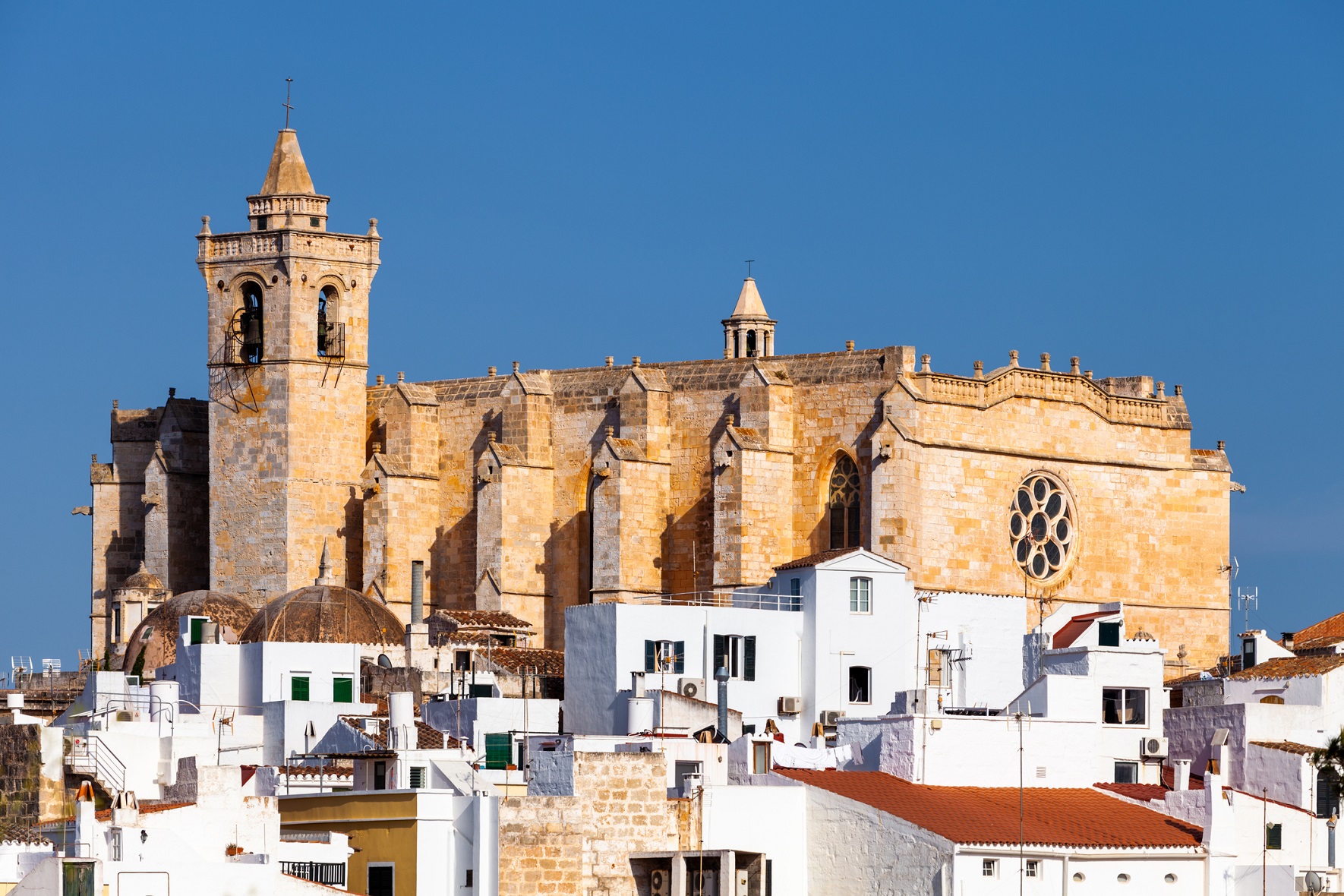
In the 13th century, a Kingdom of Majorca took shape within the complex framework of the dynasty’s possessions. Palma became an important trading centre. The Gothic cathedral, known as La Seu, and the Almudaina Palace still tell, each in its own way, of the changes of power and the wealth of this urban history.
DID YOU KNOW? The great rose window of Palma Cathedral is among the building’s most admired features. But La Seu is not just a monument: its construction spanned several centuries, at the pace of the ambitions and means of successive generations.
3. Why did the British rule Minorca?
In the 18th century, Minorca became a major strategic prize. Its position at the heart of the western Mediterranean and, above all, its vast and deep natural harbour at Mahón attracted the European naval powers. The island changed hands several times.
A harbour coveted by the great powers
The British took Minorca in 1708; their possession was recognised by the Treaty of Utrecht in 1713. They built military and port facilities there. The French seized the island in 1756, before it returned to the British in 1763. The Spanish took it back in 1782. A last British period, from 1798 to 1802, ended with the Treaty of Amiens.
These changes were not merely a succession of flags: they transformed the island’s fortifications, trade and customs. In Es Castell and around the harbour of Mahón, the architectural and military legacy of this period remains particularly easy to read.
From Minorcan gin to mayonnaise: beware of legends
Minorcan gin bears witness to a lasting British influence. Local production of this juniper-flavoured spirit has become an island tradition, now quite distinct from its military and commercial origins.
Mayonnaise, on the other hand, has a far less certain history. According to a popular theory, its name derives from Mahón, after the French captured the town in 1756. But food historians debate this etymology and the exact origin of the sauce. The anecdote is a tasty one; it is not proof.
DID YOU KNOW? No, Minorcans do not drive on the left because of the British. On the other hand, gin and some architectural traces really do recall the British presence.
4. Majorca, a land of thinkers, musicians and writers
The Balearics did not just welcome merchants and soldiers. They also attracted thinkers and artists, sometimes for very good reasons, sometimes at the cost of a few disappointments.
Ramon Llull, a medieval intellectual with universal ambitions
Born on Majorca in the 13th century, Ramon Llull is one of the great intellectual figures of the Middle Ages. Philosopher, writer and missionary, he devised a method of reasoning based on combinations of concepts and wrote in Catalan, Latin and Arabic, among other languages. His work reflects a Mediterranean shaped by exchanges between Christian, Muslim and Jewish traditions, even though his own aims were deeply religious.
Llull is a reminder that Majorca was also a place where ideas were produced and circulated. The medieval Mediterranean carried spices and fabrics, but also manuscripts, knowledge and controversies.
George Sand and Chopin: a winter in Valldemossa
In 1838, George Sand and Frédéric Chopin arrived on Majorca with the writer’s children. They hoped to find a climate good for the composer’s health. Yet their stay, notably at the Valldemossa Charterhouse, turned into a difficult experience: rain, cold, housing problems and illness complicated the winter.
George Sand drew from it A Winter in Majorca, an account in which admiration for the landscapes sits alongside sometimes harsh judgements on local society. Chopin, for his part, continued his musical work during the stay. Their visit left a considerable cultural mark, so much so that Valldemossa remains closely associated with their memory today.
DID YOU KNOW? A Winter in Majorca is not a tourist office brochure. George Sand also recounts her frustrations with a frankness that did not win her only friends on the island.
5. Two islands, two landscapes: relief, rocks and nature
Majorca and Minorca belong to the same archipelago, but they do not look the same. The first displays powerful relief, notably in the Serra de Tramuntana, while the second combines contrasting geological terrain and often gentler landscapes.
The Serra de Tramuntana, a landscape shaped by people
In the north-west of Majorca, the Serra de Tramuntana forms a long mountain range. Its highest point, the Puig Major, rises to about 1,445 metres. Its slopes bear terraces, olive groves, paths and ancient systems for collecting and distributing water. In 2011, UNESCO inscribed the Cultural Landscape of the Serra de Tramuntana on the World Heritage List, recognising this long-standing interaction between the mountain environment and human activity.
This landscape is therefore not merely “natural”. It is also the result of patient work: building dry-stone walls, channelling water, farming difficult slopes and linking isolated villages.
Minorca, a geology that changes its face
On Minorca, the geological contrasts are particularly visible between the north, where old and varied rocks come to the surface, and the south, dominated by limestone plateaus cut by ravines. This difference explains part of the diversity of the coastline: open beaches and bays in the north, numerous calas tucked into limestone cliffs in the south.
Beneath the surface, Posidonia seagrass meadows play an essential role. This marine flowering plant, not a seaweed, stabilises the seabed, provides habitats for many species and contributes to the ecological quality of coastal waters. Minorca has been a UNESCO Biosphere Reserve since 1993.
DID YOU KNOW? The brown heaps of Posidonia leaves washed up on some beaches are not necessarily “dirt” to be removed. They can protect the sand from erosion and are a sign of the coastline working naturally.
6. Pirates, watchtowers and maritime traditions
Sailing along the coasts of Majorca or Minorca, you sometimes spot a solitary tower on top of a headland. These stone silhouettes tell of a time when seeing a ship coming could be a matter of survival.
Watching the sea to protect the villages
In the early modern period, raids by corsairs from North Africa and rivalries between Mediterranean powers led to the building or strengthening of networks of watchtowers. In some areas they stood within sight of one another, so that alerts could be passed on by smoke or fire signals.
These attacks are part of a complex history of wars, maritime seizures, captivity and trade in the Mediterranean. It would be simplistic to reduce them to a clash between two shores: privateering existed on several sides and under different authorities.
The llaüt, a familiar sight in Balearic harbours
The llaüt, the traditional boat of the Balearics, is recognisable by its rounded hull and a silhouette suited to coastal activities. Historically used mainly for fishing and small-scale transport, it is now also associated with leisure sailing and maritime heritage. You still see them in harbours, alongside much more recent boats.
During a catamaran cruise between Majorca and Minorca, these details take on a different meaning: an old merchant quay, a watchtower or a traditional boat are reminders that the sea was long a route for work, travel and sometimes conflict.
DID YOU KNOW? Not all watchtowers served as lighthouses. Their main purpose was often to spot sails on the horizon and warn the population.
7. Flavours and craftsmanship: what the Balearics have passed on
The culture of the islands is also told at the table, in workshops and at markets. On Majorca, sobrasada, a soft paprika-cured sausage, is one of the emblematic specialities. The ensaïmada, a spiral pastry, reflects long-standing know-how. On Minorca, Mahón-Menorca cheese bears the name of the island’s great harbour and has a protected designation of origin.
Olive oil, dry-stone walling, basketry and other crafts show how much local resources have shaped daily life. These traditions are not frozen: they continue to be handed down, to adapt and sometimes to reinvent themselves.
As for the famous mayonnaise “born in Mahón”, it makes good conversation over a meal, as long as history is allowed not to settle the matter.
Majorca and Minorca: two characters, one shared maritime history
It would be tempting to sum up Majorca by its mountains and Minorca by its coves. That would be to miss the essential. On both islands, the landscapes, monuments and traditions tell of centuries of encounters, conquests and adaptations.
The prehistoric stones of Minorca, the palaces of Palma, the British traces in Mahón and the watchtowers along the coast make up a surprisingly rich heritage. The sea links all these stories. It carried ideas, goods, armies and inhabitants long before it became a place for leisure.
Today, discovering Majorca and Minorca by catamaran is a way to rediscover this shared geography and to observe, from the coast, some of the clues to their long history. All that remains is to look up from time to time between two swims.
How to get there
Palma de Majorca is easy to reach
By plane
Majorca airport welcomes direct flights from 140 European cities, as well as from New York during the summer season!
13 French cities are connected to Palma de Majorca. Connections are mainly seasonal (spring to autumn). The most frequent airlines are Volotea, Transavia, easyJet and Ryanair. There's bound to be a plane near you that flies to Palma.
By ferry
2 to 3 departures a week from Toulon and/or Sète to Alcudia, north of Palma, with Corsica Ferries.
Things to know before you go
CATLANTE cruises depart Mondays from early June to late September from Marina de la Lonja in Palma de Mallorca.
For EU nationals: valid identity card or passport,
Embarkation takes place at the Marina Lonja Charter port between 6pm and 7pm.
Disembarkation takes place in the morning at D+7 until 9am.
By cab:
Palma's Marina de la Lonja is about a 20-minute cab ride from Palma airport.
The average fare is €20. Choose white cabs with meters.
By bus :
From the airport, take the A1 bus (leaving every ~15 min - 5€ per ticket) to the center of Palma. Time to Plaça d'Espanya / Estació Intermodal stop: ~17-20 minutes.
At Plaça d'Espanya, change to bus line 1 towards the port. This bus runs every ~10-20 minutes (Saturdays/holidays a little less frequent). Time to a stop near La Lonja: approx. 10-15 minutes.
Arrive at the Lonja Marina Charter, located near the Portopí / Estación Marítima (final stop of bus 1). You're just a 2-3-minute walk from the dock.
It's not advisable to take a large rigid suitcase, as it won't be easy to stow in the cabin. Instead, use cabin-size luggage or travel bags/soft suitcases.
At present, we don't have a Catlante luggage locker. However, there are plenty of luggage lockers in Palma: mallorcalockers.com, stasher.com/en/luggage-luggage-luggage-luggage-luggage/palma-de-mallorca.
Stroll around the cathedral and royal palace:
Just a stone's throw from the marina, the majestic La Seu cathedral and Almudaina palace dominate the bay. A must-see to admire the Gothic architecture and sea views from the gardens of S'Hort del Rei.
Galleries and lively alleyways:
Lose yourself in the narrow streets of La Lonja, the old merchant quarter. Here you'll find art galleries, charming shady squares and Renaissance buildings to observe while sipping a drink on a terrace.
Gourmet break:
Settle down on the Plaça de la Drassana or near the Llotja de Palma to enjoy an ensaimada (local pastry) or some tapas overlooking the yachts. Numerous cafés line the promenade.
Local shopping:
Heading up towards Passeig del Born, you'll find local boutiques, Majorcan designers (leather, pearls, handicrafts) and better-known names in an elegant, tree-lined setting.
In the Balearic Islands, the currency is the euro: there's no need to change your banknotes if you're from a euro zone country. Credit cards are accepted just about everywhere, even in the smaller ports, but remember to carry a little cash for the markets and village cafés.
In terms of climate, you're in for a treat. Summer is hot and dry, but the sea breeze makes for a very pleasant atmosphere on board. The water is perfect for swimming from June onwards, and there are still plenty of sunny days until October. Nights at sea remain mild: a light sweater is all you need if the wind picks up.
The languages spoken are Castilian (Spanish) and Catalan, with local variants (Mallorquín and Menorquín). But don't worry: in ports, restaurants and stores, English and French are often spoken with a smile.
Enjoy your trip with CATLANTE Catamarans
Join as a cabin guest or charter your own catamaran with a professional crew.
An all-inclusive experience designed purely for the pleasure of sailing and discovering in a small group.
The French leader
for 20 years
The tranquility
of the all-inclusive
A local and quality
cooking
French flag,
French-speaking crews
Eco-responsible
holidays