

Overview and history
They are neighbours, share the same Caribbean waters, a turbulent history and a definite taste for volcanic landscapes. Yet Guadeloupe and Dominica have followed very different paths.
One is French, the other independent. People speak French, English, Creole – sometimes several languages in the same conversation. Their landscapes tell millions of years of geological history, while their cultures bear the marks of Amerindian peoples, colonisation, slavery and the struggle for freedom.
And then there are a few curiosities: a lake that boils in the middle of the forest, a parrot that appears on a national flag, a volcano whose name may raise a smile but which is best taken seriously, and a music born on the plantations that has become part of the heritage of humanity. In short, behind the coconut palms, there is a great deal to tell.
How did volcanoes shape Guadeloupe and Dominica?
Basse-Terre and Grande-Terre: two geological origins
Looking at a map of the Lesser Antilles, you might think all the islands came out of the same mould. That is far from the case.
Guadeloupe has a rather remarkable geographical feature: its two main islands, Basse-Terre and Grande-Terre, separated by a narrow channel called the Rivière Salée, have very different geological origins.
Basse-Terre belongs to the volcanic arc of the Lesser Antilles. Its mountains, deep valleys and soils are the result of millions of years of volcanic activity. Grande-Terre, on the other hand, is essentially made up of limestone formations of marine origin, gradually raised above sea level.
This contrast largely explains their landscapes: mountainous relief and rainforest on one side, limestone plateaus and indented coastlines on the other. And to complicate things a little, Basse-Terre (literally “low land”) is the more mountainous of the two, while Grande-Terre (“big land”) is smaller than Basse-Terre. So the names are not the best geographical guides!
La Soufrière and the volcanoes of Dominica
Guadeloupe has an active volcano, La Soufrière, whose summit rises to about 1,467 metres. Its last known magmatic eruption dates back to the 16th century, but a major phreatic crisis shook the island in 1976–1977, leading to the evacuation of tens of thousands of inhabitants.
Dominica, for its part, is almost entirely mountainous and volcanic. The island has several potentially active volcanic centres, hot springs, fumaroles and particularly numerous geothermal features.
DID YOU KNOW? In the heart of Dominica lies the Boiling Lake, a volcanic lake whose waters are heated by geothermal activity. Its centre can boil spectacularly, while thick clouds of steam rise above its surface. Clearly not the place to test the water temperature with the tip of your toe.
These phenomena are a reminder that the Lesser Antilles lie where tectonic plates meet. Beneath the island arc, the Atlantic oceanic lithosphere sinks under the Caribbean plate. This subduction fuels part of the region’s volcanic activity. And this geological story is far from over.
Who were the first inhabitants of Guadeloupe and Dominica?
The seafaring peoples of the Lesser Antilles
Long before Christopher Columbus, the islands of the Lesser Antilles were travelled and inhabited by Amerindian peoples who arrived in successive migrations, notably from northern South America.
These peoples knew how to build dugout canoes, sail between the islands, use marine resources and cultivate the land. Exchanges of pottery, raw materials and techniques bear witness to a Caribbean world that was already connected.
Among these peoples were the Kalinago, long called “Caribs” by Europeans. When the colonisers arrived, the Kalinago lived notably in Dominica, which they called Waitukubuli, generally interpreted as “tall is her body”, a reference to the island’s mountainous silhouette.
The Kalinago: a culture still alive in Dominica
Dominica long resisted permanent European colonisation. Its rugged terrain, its forests and the resistance of the indigenous population hampered French and British attempts to settle.
Guadeloupe had a different history. From the 17th century onwards, the arrival of French settlers led to violent conflicts, displacement and the gradual marginalisation of the Kalinago. But in Dominica, a Kalinago community has kept a territorial presence to this day.
DID YOU KNOW? On Dominica’s east coast lies a Kalinago territory of about 15 km², officially established at the beginning of the 20th century. Its inhabitants preserve and reinvent cultural, craft and community practices, including basket-weaving traditions using local plant fibres. The history of the Caribbean’s first peoples does not belong only in museums: it is still being written.
In Guadeloupe, the Amerindian presence is discovered mainly through archaeology, place names and history; in Dominica, it is also embodied in a contemporary indigenous community.
How did colonisation shape the two islands?
Guadeloupe and Dominica were caught up in the rivalries between European powers, particularly France and Great Britain. From the 17th century, sugar cane cultivation profoundly transformed the economies and societies of the Antilles. The plantations relied on the forced labour of African people who had been deported and enslaved. But the political paths of the two islands eventually diverged.
Slavery and the resistance of Louis Delgrès in Guadeloupe
The French Revolution had led to a first abolition of slavery in 1794. Eight years later, under Bonaparte, a French military expedition arrived in Guadeloupe. It met the resistance of several officers and soldiers, notably Louis Delgrès and Joseph Ignace, who refused the return of the slave order.
Delgrès had a proclamation published that became famous, addressed “To the whole universe, the last cry of innocence and despair”. On 28 May 1802, surrounded with his companions at Matouba, he chose to blow up their position rather than surrender. Slavery was restored in the colony shortly afterwards. Its final abolition in Guadeloupe would not come until 1848.
DID YOU KNOW? The resistance of Louis Delgrès is now associated with the motto “Live free or die”. His name was given to a fort in Basse-Terre, formerly Fort Saint-Charles. The site is a reminder that Guadeloupe’s history is not just about plantations: it is also the story of the women and men who fought against slavery.
Independent Dominica, French Guadeloupe
Dominica came permanently under British rule in the 18th century, although French influence remains strong in its culture and Creole language. Slavery was abolished there as part of British emancipation in the 1830s.
On 3 November 1978, Dominica became an independent republic. Its official name is the Commonwealth of Dominica, not to be confused with the Dominican Republic, located on the island of Hispaniola.
Guadeloupe, for its part, became a French department in 1946, before also acquiring the status of a region. Today, the two territories belong to different political entities: Guadeloupe is part of France and the European Union, while Dominica is a sovereign state. A few dozen kilometres of sea separate them, but their institutions tell two distinct stories.
Why is the rainforest so rich on these islands?
Trade winds, mountains and cloud forest
In Guadeloupe as in Dominica, rainforest covers much of the mountainous terrain. But why are some areas so wet, while others, sometimes only a few kilometres away, have a much drier climate?
It all starts with the trade winds, those steady winds that blow mainly from the east. Laden with moisture over the Atlantic, they meet the mountains, rise, cool and bring heavy rainfall. This is known as the orographic effect. The name is a little technical, but the principle is simple: the mountain forces the clouds to empty part of their load.
The result: on the windward slopes, rainfall can be considerable. On the other side of the mountains, some areas are more sheltered.
The rainforest is not a uniform environment. As you climb, the temperature drops, humidity changes and the vegetation is transformed. In the wettest areas grow imposing trees, tree ferns, mosses and many epiphytic plants. These grow on other plants without being parasites.
Higher up, the trees sometimes become smaller and twisted, shaped by the wind, constant humidity and harsher conditions. These are known as cloud forests or montane forests.
Morne Trois Pitons National Park and the sisserou parrot
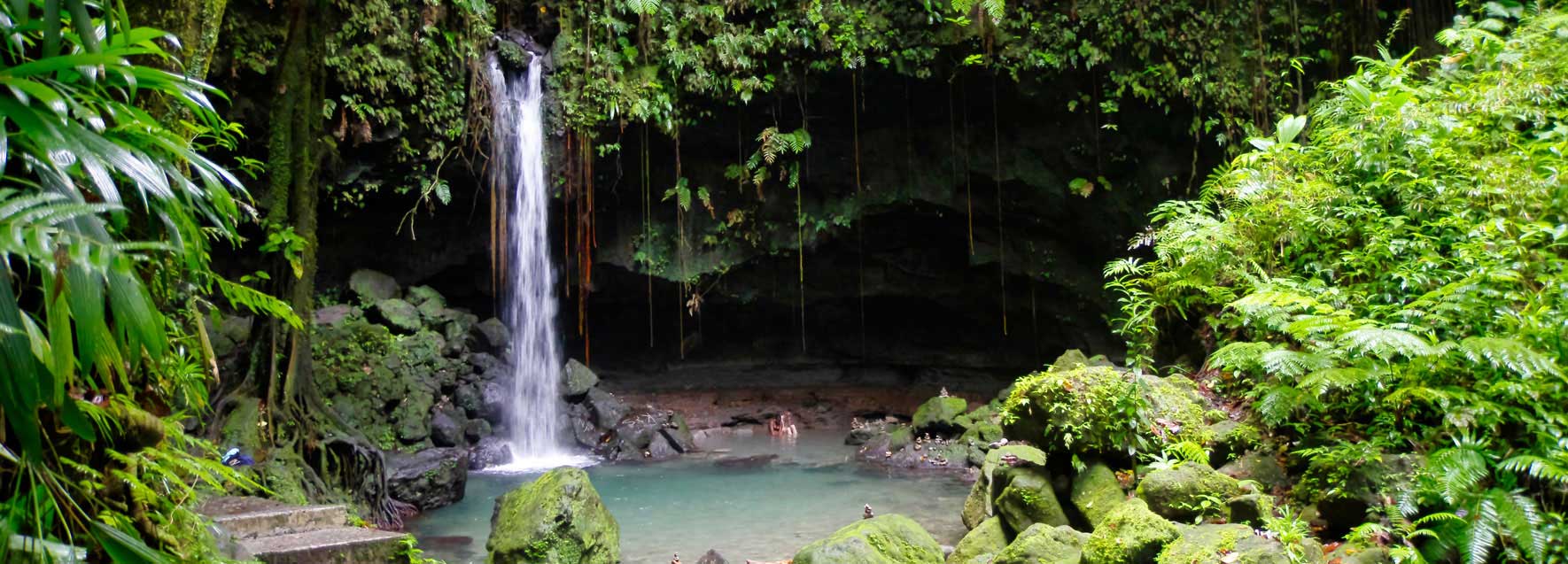
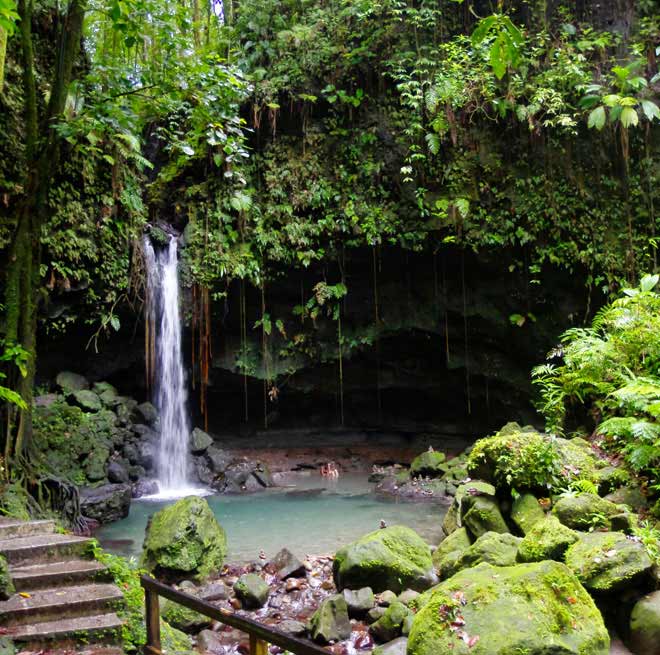
Dominica has one of the best-preserved forest areas in the Lesser Antilles. Its Morne Trois Pitons National Park, a UNESCO World Heritage Site since 1997, brings together nearly 7,000 hectares of rainforest, lakes, waterfalls and several volcanic centres.
DID YOU KNOW? Dominica is home to a bird found naturally nowhere else: the imperial amazon, known as the sisserou. This large parrot, recognisable by its green and purplish plumage, is so emblematic that it features in the centre of the national flag. Few countries have chosen such a rare bird to represent their identity. And unlike many national emblems, this one can actually fly!
Guadeloupe also has remarkable biodiversity, with species endemic to the Lesser Antilles, notably among birds, reptiles and amphibians. The richness of these forests does not lie only in the number of species they shelter. They help regulate water, protect the soil and maintain the ecological balance of island territories that are particularly sensitive to climate change.
What are the origins of Creole languages and music?
Creole languages on both sides of the sea
Two neighbouring islands, two official languages: French in Guadeloupe, English in Dominica. But just listen carefully and you will discover that the linguistic reality is far more interesting.
The two territories share an important Creole heritage. Guadeloupean Creole and Dominican Creole belong to the family of French-based Creoles, even though they differ in vocabulary, pronunciation and usage.
These languages were born in colonial societies, through contact between populations of diverse origins, in a context deeply marked by slavery. They have their own grammar and their own rules. They are not approximate versions of French, but languages in their own right.
Guadeloupean gwoka and Dominica’s musical traditions
In Guadeloupe, gwoka holds a special place in the musical heritage. Rooted in the history of enslaved African peoples, it combines song, percussion and dance. Ka drums accompany traditional rhythms, while the singer and dancers may improvise.
Gwoka is much more than a musical genre. It is a form of collective expression, linked to memory, emotions, gatherings and Guadeloupean identity. In 2014, it was inscribed on UNESCO’s Representative List of the Intangible Cultural Heritage of Humanity.
DID YOU KNOW? Traditional gwoka is generally associated with seven main rhythms, including toumblak, graj and léwòz. Each has its own personality and uses. Improvisation plays an essential role: musicians, singers and dancers converse with one another, sometimes without having rehearsed together. A conversation of sorts – but with drums.
Dominica has developed an original musical culture, at the crossroads of African, French, British and Caribbean influences. Its traditional forms include bélé, which combines percussion, song and dance. Other musical forms, such as jing ping, use the accordion and rhythm instruments.
In the 1970s, the band Exile One, founded by Dominican musician Gordon Henderson, helped develop cadence-lypso, a style blending Haitian and Caribbean influences. This music then contributed to the emergence of zouk, which enjoyed huge success in the French Antilles from the 1980s.
Musical exchanges between Guadeloupe and Dominica are therefore nothing new. Influences have travelled in both directions, carried by musicians, Creole languages and population movements. And after all, what could be more logical in a region where the sea has always been a space for travel?
Guadeloupe and Dominica: two ways of being Caribbean
Guadeloupe and Dominica share a geological history, Amerindian and African heritage, Creole traditions and a close relationship with the sea. But their differences are just as instructive.
Guadeloupe tells the story of a territory that became French, marked by the struggle against slavery and a strong Creole identity. Dominica bears witness to another path: that of an island that became independent, where Kalinago culture is still alive and where the forest still occupies an exceptional place.
These two territories illustrate the full complexity of the Caribbean: a world of islands that are close but never identical, where geography, peoples and history have produced remarkable cultural diversity. And once you know a little more about their stories, you never look at these islands in quite the same way again.
How to get there
Reach Guadeloupe easily
By plane
- From Paris by direct flight: Air France / Air Caraïbes / Corsair (approx. 9h flight)
- From other major French cities: Air Caraïbes (offers train+plane packages with transfers between the TGV station and the airport), Air France with a stopover in Paris, Corsair (offers train+plane packages with transfers between the TGV station and the airport).
- From Belgium: Air Caraïbes from Brussels with a stopover in Paris
- From Switzerland: Air France from Geneva with a stopover in Paris
- From Luxembourg: Air France from Luxembourg with a stopover in Paris
Things to know before you go
For EU nationals: valid identity card or passport, authorization to leave the country for minors traveling without at least one parent or legal guardian.
Departure from Guadeloupe: boarding takes place at the Bas du Fort marina in Pointe-à-Pitre at 6pm. Disembarkation takes place in the morning of D+7 at 9am.
Departure from Martinique: boarding takes place at Le Marin marina at 6pm. Disembarkation takes place in the morning of D+7 at 9am.
In Guadeloupe: cabs from the airport. Approx. €30 to Bas du Fort marina.
In Martinique: ANTILLES TOURS - Patrick PENELOPE Tel +596 6 96 28 80 22 - antilles-tours@wanadoo.fr You must confirm your one-way reservation by e-mail to Antilles Tours, mentioning the number of passengers, date and flight number. Payment upon reservation or to the driver. Individual or group transfer from the Airport to the Port of Le Marin or return: €15 per trip and per passenger (based on a minimum of 2). Outward journey: Welcome near gate E to the right of passenger arrival after Customs with a CATLANTE sign and your name. Return trip: Departure 9:30 am from Le Marin to Les Trois Ilets with luggage pick-up. Lunch at leisure (not included). Afternoon departure for the airport (schedule depends on 1st flight). If some passengers have a later flight and wish to postpone their transfer, €30 supplement. Hotel transfer depending on distance, supplement €15 to €30 one-way per person. Return booking and payment on site.
No information at this time
It's not advisable to take a large rigid suitcase, which won't be easy to stow in the cabin. Instead, use cabin-size luggage or travel bags/soft suitcases. At Le Marin marina: Croisière Sans Bagages next to the SNSM rescue station - Mail : contact@bagdropcruise.com - Tel / WhatsApp : +596 696 097 972 - Mon - Sun : 8h30 - 18h, open on public holidays Go to the address below: hand in your clean luggage, which must not exceed 23 kg. You will be asked for your identity papers at drop-off and pick-up, and for confirmation of your cruise. Drop-off all day until 6pm = 8 euros per bag / Drop-off from 1pm until 6pm = 5 euros per bag
Excursion to discover the Indian River in Portsmouth: €30 per person
Excursion to Titou Gorge and Trafalgar Falls from Mero Beach: €30 per person.
Electric bike rental in Les Saintes: €25 to €32 per day.
In Guadeloupe, the currency is the Euro. In Dominica, the Euro and the US dollar are accepted (bring €50 to €100 in cash for your stopover in Dominica). The West Indies have a tropical climate, with a dry season from November to April. English, French and Creole are spoken in Dominica.
Enjoy your trip with CATLANTE Catamarans
Join as a cabin guest or charter your own catamaran with a professional crew.
An all-inclusive experience designed purely for the pleasure of sailing and discovering in a small group.
The French leader
for 20 years
The tranquility
of the all-inclusive
A local and quality
cooking
French flag,
French-speaking crews
Eco-responsible
holidays