

Overview and history
Saint Martin is split between France and the Netherlands. Anguilla staged a revolution so as not to depend on St Kitts. As for Saint Barthélemy, it belonged to Sweden for almost a century, which explains why its main port bears the name of a Scandinavian king.
Today, these three neighbours attract an international clientele and each cultivates a distinct personality. But before the villas, hotels and yachts, there were Amerindian peoples, salt ponds, plantations, fishermen, merchants and enslaved people, not to mention a few frankly unexpected political episodes.
And if you go back even further, you discover that these three islands were once a single one. This little corner of the Caribbean certainly has plenty of stories to tell.
How did Saint Martin, Anguilla and Saint Barthélemy form?
We have to go back some 20,000 years, to the last Ice Age. At that time, a considerable amount of water was locked up in the great ice sheets. Sea levels were more than 100 metres lower than they are today.
Saint Martin, Anguilla and Saint Barthélemy sit on the same shallow submarine plateau, known as the Anguilla Bank. When the sea was much lower, large parts of this plateau were above water and connected the islands we know today.
In other words, 20,000 years ago you could walk from Saint Martin to Anguilla. Today, a catamaran cruise is still a far more pleasant way to get from one island to the other!
The gradual rise of the oceans after the last glaciation flooded the low-lying land and cut the three islands off from one another.
One origin, very different landscapes
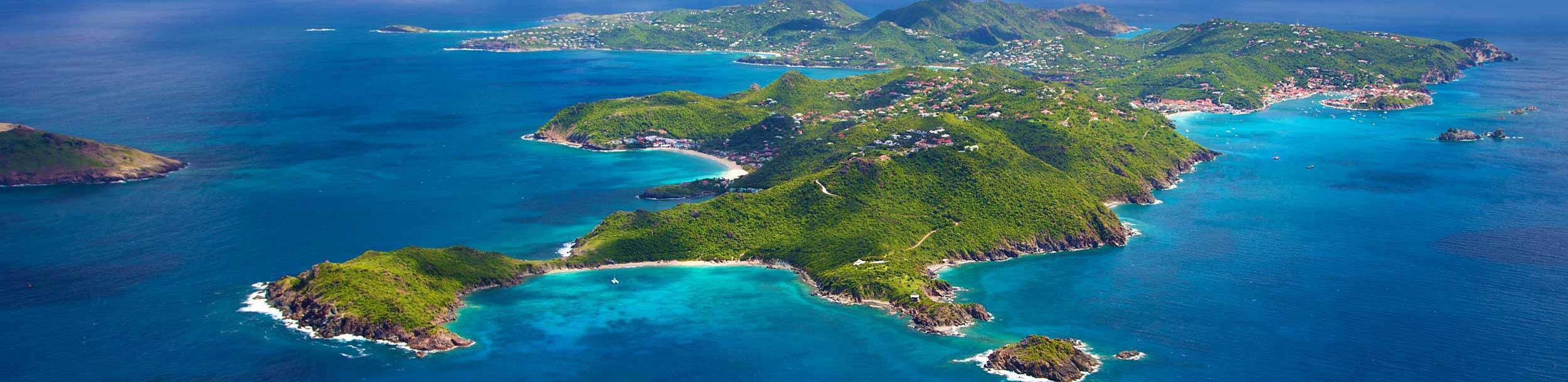
Saint Martin and Saint Barthélemy have rocky landscapes shaped by a complex geological history, marked in particular by ancient volcanism and tectonic changes. Anguilla, much flatter, is largely made up of marine limestone formations. Its highest point reaches only about 65 metres.
That is why these three neighbours have such different silhouettes: hills and small mountains on Saint Martin and Saint Barthélemy, low plateaus and limestone coasts on Anguilla.
DID YOU KNOW? The Anguilla Bank is also a biological territory. Its shallow waters are home to reefs, seagrass beds and habitats essential to many species. Political borders are recent on a geological timescale. The fish, for their part, still don’t seem very concerned.
And human history begins long before these borders appeared.
Why is Saint Martin divided between France and the Netherlands?
Saint Martin has a rare feature: this island of about 87 km² is shared between two territories belonging to two European states. In the north, Saint-Martin is a French overseas collectivity. In the south, Sint Maarten is an autonomous country within the Kingdom of the Netherlands.
The Treaty of Concordia, or the art of sharing an island
In 1648, the French and the Dutch concluded an agreement known as the Treaty of Concordia. It organised their coexistence on the island and became the historical reference for the territorial division.
But the exact origin of the border line gave rise to a far more amusing legend. According to tradition, a Frenchman and a Dutchman set off on foot, each in the opposite direction, to walk around the island. The point where they met was supposed to set the border.
The Frenchman is said to have covered a greater distance, which would explain why the French side is larger. Some versions add that the Frenchman had been drinking wine, while the Dutchman had opted for something stronger. An explanation that probably says more about national jokes than about geography.
DID YOU KNOW? The story of the two walkers is a legend, not a historically proven method of drawing a border. The division is real, but some border areas have been the subject of diplomatic discussions right up to modern times. So you can share an island for almost four centuries and still be debating exactly where the border runs.
Two administrations, but a largely shared history
The land border has not always been a strong divide in daily life. Families, traders and workers have long moved between the two sides. Languages, traditions and economic activities developed within a shared island space.
French and Dutch are the official languages in their respective territories, but English plays a major role in everyday life on both sides of the island. This predominance stems from the history of the population and from regional exchanges.
On Saint Martin, cultural identities cannot simply be read off a political map. To understand how this society took shape, you also have to look at the salt ponds, the plantations and the history of slavery.
Why did Saint Barthélemy belong to Sweden?
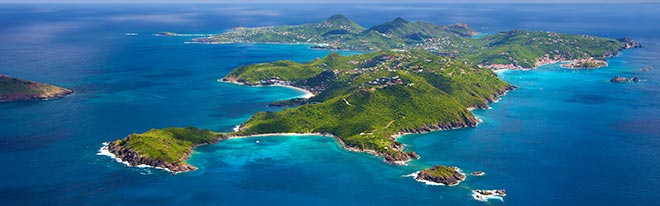
Today, Saint Barthélemy is associated with a certain idea of luxury, with yachts and villas discreetly set on the hillsides. But its history holds a surprise: for almost a century, this small island of the Antilles belonged to the Kingdom of Sweden.
It all began in 1784, when Louis XVI concluded an agreement with King Gustav III. France ceded Saint Barthélemy to Sweden, which in return granted the French trading advantages in the port of Gothenburg.
The island had neither the agricultural resources nor the climate that made the fortune of the great sugar colonies. Its terrain is rugged, farmland is limited and fresh water relatively scarce. On the other hand, it had one major asset: a natural harbour well placed on the trade routes of the Lesser Antilles.
Gustavia, the free port of the Caribbean
The Swedes developed the port of Le Carénage, renamed Gustavia in honour of King Gustav III, and granted it free-port status. Goods could pass through it with customs advantages. Merchants of various nationalities settled there and trading ships called at its quays.
In the late 18th and early 19th centuries, Gustavia became an important trading hub, benefiting in particular from the wars between the European powers. Swedish neutrality was an advantage for trade, legal or otherwise, between the colonies.
This prosperity did not last forever. With the return of peace and the transformation of international trade, Gustavia’s commercial role declined. In 1878, the island became French again.
DID YOU KNOW? The name Gustavia is not the only Swedish legacy. The town still has remains of fortifications and traces of its old colonial layout. Today, people go to St Barths to enjoy a little corner of France, even though its main town still bears the name of a Swedish king.
A Swedish story that is not just about trade
It would be misleading to tell this period solely as an adventure of Scandinavian merchants in the tropics. Saint Barthélemy was also a slave society. People of African origin were enslaved there, notably in domestic, port and commercial activities.
Sweden took part in this colonial system and in the economy of the slave trade, a reality that long featured little in popular accounts of the island. Slavery was abolished there in 1847, one year before the French abolition of 1848.
Saint Barthélemy therefore carries a far more complex history than its current image suggests: a small French island that became Swedish, was turned into an international port, then returned to France.
How did Anguilla have its revolution?
Anguilla has a personality all its own. Flatter than its neighbours and relatively arid, it long remained on the margins of the region’s major economic and political routes. Its name is said to come from its elongated shape, reminiscent of an eel.
The Amerindian peoples who lived there long before the Europeans knew it by another name: Malliouhana, often interpreted as a reference to a sea serpent. Archaeological remains bear witness to a human presence dating back several thousand years.
A colony that no longer wanted to depend on St Kitts
During the British period, Anguilla was administratively linked to St Kitts and Nevis, two islands located much further south. This arrangement caused deep resentment among the inhabitants, who felt their island was neglected by the authorities based in St Kitts.
In 1967, when St Kitts, Nevis and Anguilla became a State in association with the United Kingdom, the Anguillians rejected this new arrangement. On 30 May, they expelled the police officers sent from St Kitts. A provisional government was formed and the islanders declared their wish to separate from St Kitts. The episode quickly became known as the Anguillian Revolution.
When the British landed
Negotiations became complicated and Anguilla unilaterally declared its independence in 1969. On 19 March of that same year, British troops landed on the island to regain control of the situation.
The intervention caused quite a stir, not least because the little island hardly fitted the description of a threatening military power. But the political stakes were real: Anguilla refused to return to St Kitts’ authority.
After several years of talks, it was officially separated from St Kitts and Nevis in 1980. Today, Anguilla is a British Overseas Territory with its own local institutions, but it is not an independent state.
DID YOU KNOW? 30 May is celebrated as Anguilla Day, in memory of the 1967 revolution. The Anguillians were not fighting to break away from the United Kingdom: above all, they no longer wanted to depend on St Kitts. A revolution to remain British: that certainly deserves its place among the political curiosities of the Caribbean!
This revolution has become a key part of Anguillian identity. It tells of a small island population’s attachment to its autonomy and to the freedom to decide its own future.
What did the islanders live on before tourism?
Before becoming international tourist destinations, Saint Martin, Anguilla and Saint Barthélemy lived in an environment where resources were limited. Their relatively dry land and the lack of fresh water did not everywhere favour large sugar plantations, unlike other islands of the Antilles.
But they had a sometimes underestimated source of wealth: the sea. It provided fish, made it possible to trade with neighbouring islands and offered a resource that was highly sought after for centuries: salt.
Salt, the Caribbean’s old treasure
Before refrigeration became widespread, salt was essential for preserving food. On Saint Martin, the large salt ponds long played a central role in the economy. The Great Salt Pond, near Philipsburg, was one of the main production sites.
Seawater was concentrated there by evaporation, then the salt was harvested and shipped out by boat. This activity required a great deal of physical labour and relied on a workforce that, for a long time, was partly made up of enslaved people.
Anguilla also had salt ponds, notably around Road Bay and Sandy Ground. On Saint Barthélemy, where farming was held back by the lack of water, sailing and inter-island trade played a particularly important role.
In Anguilla, boats are serious business
Anguilla’s maritime tradition has one particular feature: traditional sailboat racing holds a major place in popular culture. Boat racing is generally regarded as the island’s national sport.
Crews compete on sailing boats designed for local waters. The races draw large crowds, and every boat has its own supporters.
DID YOU KNOW? In Anguilla, a traditional sailboat race can stir as much passion as a big football match elsewhere. The regattas are not just a show for visitors: they are part of the island’s identity. Which makes it easier to understand why, in these parts, it is best not to criticise your neighbour’s boat.
Long before the Europeans, sailors were already crossing these waters
This maritime culture goes back much further than the colonial period. Archaeological excavations on Saint Martin have revealed traces of human occupation dating back several thousand years. At Orient Bay, archaeologists have found Amerindian camps, tools made of stone, shell or coral, and traces of food preparation.
On Anguilla, research has shown that pre-Columbian peoples were already trading with Saint Martin, in particular to obtain certain stones used to make tools.
Long before catamaran cruises made it possible to discover these islands from one anchorage to the next, traditional boats carried the exchanges between communities. The sea was not an obstacle: it was their main means of communication.
How did these islands become international destinations?
In the mid-20th century, the three islands were still relatively undeveloped in terms of tourism. Their economies relied on traditional activities, regional trade and, for some families, on money sent home by relatives who had gone to work elsewhere.
Then aviation, infrastructure and the growth of international tourism would profoundly change their destiny. But each would develop a model of its own.
Saint Barthélemy, the art of cultivating rarity
Tourism on Saint Barthélemy began to take shape in the 1950s, with the arrival of wealthy visitors, many of them North American. Among the personalities associated with the beginnings of this fame was David Rockefeller, who bought a property on the island.
Gradually, Saint Barthélemy attracted an international clientele drawn by its island character, its climate and a certain discretion. Hotel and property development largely focused on the upmarket segment, with small hotels, villas and specialised establishments.
Its airport, located in Saint-Jean, adds to its uniqueness. Its short runway, framed by the hills and the sea, imposes particular constraints on the aircraft allowed to land there.
DID YOU KNOW? Saint Barthélemy has an airport with a runway about 650 metres long. Pilots must hold qualifications suited to the particularities of its approach. Here is a destination where the trip sometimes begins with a demonstration of aeronautical precision.
Anguilla, luxury without the bustle
Anguilla gradually developed upmarket tourism based on a different promise: space, peace and quiet, and relatively low-density tourist development. It attracts in particular a North American clientele looking for beaches, refined hotels and a less hectic setting.
The contrast with Saint Barthélemy is interesting: both islands welcome a well-off clientele, but they do not cultivate quite the same art of living. One has built an international society reputation; the other puts more emphasis on discretion.
Saint Martin, cosmopolitanism as identity
The Dutch side of Saint Martin has strongly developed international tourism, port infrastructure, shopping and leisure activities. The French side also attracts visitors, with a tourist and residential offer set within a different administrative framework.
Princess Juliana International Airport, on the Dutch side, helps make the island a major gateway to the neighbouring islands. Its location next to Maho Beach has become famous: planes pass low over the shore on their approach.
But behind this much-photographed image lies an essential economic reality: the airport facilitates trade and access to this whole part of the Lesser Antilles.
Three models, one transformation
In a few decades, the three islands went from economies largely based on local resources and regional trade to societies in which tourism plays a major role.
This transformation brings infrastructure and jobs, but also challenges: pressure on land, the cost of living, water management, dependence on transport and vulnerability to hurricanes. Hurricane Irma, in September 2017, was a reminder of how fragile these territories are.
Their future therefore depends on their ability to reconcile economic development, environmental protection and the quality of life of their inhabitants.
Very Important Islands, and not only for their visitors
Three islands born of the same geological whole, inhabited for thousands of years by seafaring peoples, then drawn into the rivalries of the colonial powers. One was divided between the French and the Dutch. Another belonged to Sweden before becoming French again. The third staged a revolution so as no longer to depend on its political neighbours.
Salt, fishing, boats and maritime trade long set the rhythm of their daily lives, before international tourism profoundly transformed their economy.
Today, discovering Saint Martin, Anguilla and Saint Barthélemy on a catamaran cruise also means rediscovering this shared geography and this long history of sailing between the islands.
Very Important Islands, without a doubt. But for many more reasons than you might first imagine.
How to get there
Reach Saint Martin easily
By plane
- From Paris: Air France (direct, arriving at Princess Juliana airport on the Dutch side) / Air Caraïbes (with a stopover at Pointe-à-pitre and arriving at Grand Case airport on the French side) (approx. 9hrs flight)
- From other major French cities: Air France with a stopover in Paris
- From Belgium: Air France from Brussels with a stopover in Paris (train+plane package)
- From Switzerland: Air France from Geneva with a stopover in Paris
- From Luxembourg: Luxair + Air France from Luxembourg with a stopover in Paris,
Things to know before you go
CATLANTE cruises depart from the Fort Louis marina in Marigot on the island of Saint Martin on Saturdays from November to April.
For EU nationals: passport must be valid for at least six months after the end of the cruise, for each participant. Authorization to leave the country for minors traveling without at least one parent or legal guardian.
Boarding takes place at the Fort-Louis marina in Marigot at 6pm. Disembarkation takes place on the morning of day 8 (D+7) at 9am.
Cabs at Princess Juliana airport in St Martin: check that the vehicle has a cab plate on the roof, to avoid pirates.
Carry US dollars with you, as rates (around $30 for 2) will be the same in euros.
At Grand Case airport (flights from Guadeloupe): cab Jean Philippe 06 90 87 47 92 or 06 90 55 96 15 Call on behalf of Catlante. It's best to book when you board your regional flight.
Luggage storage at the Wine Bar, just opposite the pontoon entrance to Marigot's Fort Louis marina. €5 per bag, Saturday between 11am and 6pm.
Rent a car for a day in St Barth to discover the island.
In Saint-Martin, Anguilla and St Barth, the most widely used currency is the US dollar. Be sure to carry a few hundred in cash.
The climate in the West Indies is tropical, with the dry season running from November to April.
The official language is French in St-Martin and St Barth (English and Dutch in the Dutch part of the island) and English in Anguilla.
Enjoy your trip with CATLANTE Catamarans
Join as a cabin guest or charter your own catamaran with a professional crew.
An all-inclusive experience designed purely for the pleasure of sailing and discovering in a small group.
The French leader
for 20 years
The tranquility
of the all-inclusive
A local and quality
cooking
French flag,
French-speaking crews
Eco-responsible
holidays